PermBase: Executive Communication for the Future · Chapter 1 · By Clarke Curran · · 25 min read
Chapter 1: The Method
This chapter is the whole of PermBase. Everything after it is practice.
It’s not about you. It’s about them.
This is the rule beneath everything in this book. If you can satisfy the other person’s needs in communication, you earn the opportunity to include your own. Them first. The order matters.
You address the emotional state before the object of the communication. If you go to the object first, your language becomes direct and inconsiderate. Emotional state, then object. No exceptions.
Emotional state means considering the other person and respecting their boundary. You do not know what is occurring in their life, so you approach with respect and courtesy. Only then do you raise the object: the task, action, or request.
If you focus on the object without considering the person, you can cross the line. They may feel used, disrespected, unwanted, or worthless. You may also add to a personal problem you know nothing about.
Consider a simple request:
“Hi John, if you don’t mind, may I ask you a quick question?”
The manager needs a report, but that need has not yet appeared. John’s need comes first: his attention is his to give. Only after he has given it does the request enter the conversation. Every technique in this book follows that order.
Who this book is for
This book is written for senior professionals: executives, directors, managers, and anyone who communicates across teams, levels, and organisations. It assumes you know how business works. It does not explain the basics, and it does not motivate. It teaches a method.
The method focuses on others. If you are looking for a way to have your own needs met at work, this book will not be helpful.
What PermBase is, and is not
PermBase is a method of professional communication for the modern workplace, applied at the highest level of an organisation. Its name comes from its foundation: permission-based communication.
It is a communication method first. Leadership is one place it is applied, but this is not a leadership book, and it is not a book about national or organisational culture. It is pure communication technique for the professional world.
Every scenario in this book is an illustration, written to show the method at work. Where research is cited, the source is listed at the end, and the book says plainly where the evidence is limited.
Why PermBase exists
For most of the history of organised work, communication flowed one way: down. A person with authority spoke, and a person without it complied. Direct speech was efficient, and compliance was expected. That style worked in a world that accepted it.
The professional world you work in today is different. People are more individual. They expect to be addressed as individuals, and they bring their own judgement, ideas, and standards to their work. A request that would once have been obeyed without thought may now be received as an imposition, and an order as disrespect.
PermBase is a response to that change.
Founding statement. PermBase treats every person as an independent contributor whose autonomy sits behind a boundary. We do not cross that boundary without permission. It’s not about me; it’s about them. When we make it about them, our thinking moves towards understanding rather than force. People who are invited to contribute in their own way collaborate by choice, not by compliance.
| The older style | PermBase | |
|---|---|---|
| Starting point | The task | The person |
| Assumption | People will comply | People will contribute when respected |
| Typical sentence | “Have it on my desk by Friday.” | “Do you think it would be possible to have it by Friday?” |
| Source of cooperation | Authority | Relationship |
| Result | Compliance | Collaboration by choice |
None of this removes authority. Organisations still set directions, deadlines, and requirements. PermBase changes how those are communicated, not whether they exist.
The more senior you are, the more weight your words carry, and the easier it is to cross a boundary without noticing. A request from a senior executive is rarely heard as optional. That is why the method matters most at the top.
What the research says. The central idea, that people respond better when their autonomy is respected, has support in research on motivation. Self-determination theory identifies autonomy as one of three basic psychological needs, and workplace studies link autonomy-supportive management to higher motivation and well-being (Ryan and Deci, 2000; Gagné and Deci, 2005)12. Two cautions apply. Most of this research is correlational, so it shows association more strongly than cause. And popular claims that a particular generation needs a different style rest on weak evidence. PermBase does not depend on those claims. It rests on a simpler position: respect for a person’s autonomy is good professional practice, whoever that person is.
The core rule
It’s not about me. It’s about them. No exceptions.
Emotional state, then object.
Every conversation has two parts: the person and the matter. The core rule decides their order. The person comes first, always.
Emotional state is the person: their attention, their time, their mood, and their boundary. They may have just received difficult news, be under pressure from another deadline, or be concentrating on work that matters to them. You approach with respect and courtesy, and you let them decide when to give you their attention.
Object is the matter: the task, the action, or the request. It is the reason you are speaking, but it is not where you begin.
Why the order matters
When you begin with the object, your words are about your need. The other person hears a demand on their time before they have agreed to give it. However polite the words, the order tells them that the task matters more than they do.
When you begin with the emotional state, your first words are about them. You ask for their attention instead of taking it. By the time the object arrives, they have chosen to receive it.
Illustration.
- Object first: “John, I need the report by Friday.”
- Emotional state first: “Hi John, if you don’t mind, may I ask you a quick question?”
In the first version, John’s attention was taken. In the second, it was asked for.
The rule shapes your thinking
The core rule changes how you think before you speak. When you make the communication about the other person, you begin to consider their position: what they are carrying, what they might need, and how your request lands on them. Your thinking moves towards understanding the person rather than forcing an action. This mindset is the golden method of communication. The polite words follow from it.
What the rule is not
The core rule does not mean flattery, and it does not mean avoiding the request. You still make the request, clearly and specifically. You make it second. It also does not mean long preambles. One courteous sentence is often enough. The rule is about order and respect, not length.
Illustration: a senior leader.
- Object first: “Please approve the budget line today.”
- PermBase: “Good morning, Ms Lee. I hope your week is going well. May I ask for two minutes of your time today on one budget decision?”
Illustration: after a difficult meeting.
- Object first: “We need to fix the client issue now.”
- PermBase: “Hi David, that was a demanding meeting. Whenever you are ready, may I speak with you about the client issue?”
Autonomy and the boundary
Picture every person you work with surrounded by a line. That line is their boundary. Behind it sits their autonomy: their right to decide what they give their attention, time, and effort to.
Autonomy is the core element of PermBase. The boundary exists to protect it. Permission is how you ask to cross it.
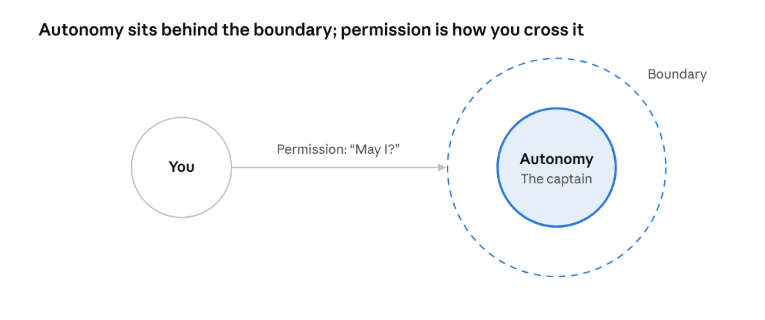
You stand outside the boundary. Permission is the way in, and autonomy, the captain, stays in charge behind it.
Time and energy are the currency
Time and energy are the currency every person has. When you ask someone to read a message, attend a meeting, or complete a task, you are asking them to spend that currency on your behalf.
This is true even when the person is paid and obligated to do the work. Their salary creates an agreement about the work, not a right to command the person. So you ask politely when you manage and allocate work, every time.
Imposition
An imposition is any demand on another person’s attention, time, workload, or freedom to refuse. Every request is an imposition, however small. That is not a reason to stop asking. It is a reason to ask with care, and to match your care to the size of what you are asking.
| Size of imposition | Example | How much care |
|---|---|---|
| Small | A one-line answer to a question | A courteous opening and a clear request |
| Medium | Reviewing a two-page summary by Thursday | Ask for attention first, then make the request |
| Large | Taking on a new project for three months | Ask for time to talk, explain, invite their view, and give them room to consider |
Research on politeness supports this scaling. Brown and Levinson’s model weighs any request by the social distance between the people, the power between them, and the size of the imposition (Brown and Levinson, 1987)3. Their claim that the model applies in every culture has been questioned (Matsumoto, 1988)4, so this book uses it as a working guide for professional settings, not a universal law.
Politeness is the external consideration
Autonomy belongs to the other person. Politeness belongs to you. It is how you conduct yourself when you approach someone else’s autonomy: your words, your timing, and your tone. It is the visible sign that you have recognised the boundary. Without it, even a reasonable request reads as a trespass.
Illustration: allocating work.
- Crossing the boundary: “I’ve given you the vendor review. It’s due Monday.”
- Respecting the boundary: “Hi Sam, may I ask you a quick question? Do you think it would be possible to take on the vendor review? It would need to be ready by Monday. What do you think?”
Boat theory and the fleet
Boat theory is the picture at the heart of PermBase. It explains, in one image, why the method asks before it speaks.
The old model: one ship, one captain
Imagine a ship with a single captain and a hierarchy to run it. When a person joins the ship as crew, their permissions are waived. They are given orders: more speed, turn left, turn right, lights on. One captain directs many people under management. Collaboration is assumed, because everyone is on the same ship and answers to the same captain.
The PermBase model: every person captains their own boat
PermBase sees the workplace differently. Every person is the captain of their own boat. Their boundary is the edge of that boat, and it protects their autonomy.
When you communicate with someone, you are a visitor asking to come aboard. You are on their turf, so you ask; you do not command.
This holds even when they are paid to be there and obligated by contract. Tyrannical or dictatorial methods are never used. You want people to want to do great work, and that means the relationship comes first. People do great work for the people they like, respect, and admire.
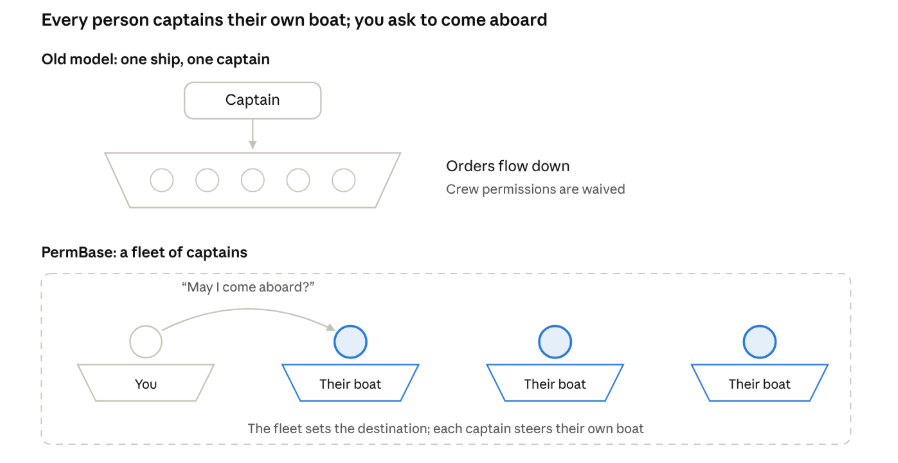
On the old ship, orders flow down and permissions are waived. In the PermBase fleet, every person captains their own boat, and you ask before you come aboard.
Coming aboard
Every PermBase conversation is a visit to another person’s boat. It happens in two moves, and it stays polite, formal, and diplomatic throughout.
- Permission to board. “Hi John, may I please come and speak to you?”
- Permission for the request. “What do you think about this report? Do you think you would be able to have it done by Friday?”
The first move asks for their attention. The second asks for their effort. Neither is assumed.
The fleet
An organisation is a fleet: many groups, teams, and systems moving in the same direction. Within the fleet, you still respect the person behind each boundary.
The fleet has a destination. The CEO, a director, a manager, or a team sets that destination after considering other people’s contributions, and then a decision is made. One person can still make a decision, and others can contribute input on it. Planning and direction are still carried out, while others share their opinions and views.
Sometimes people contribute for the sake of contributing. When that happens, let it play out respectfully. A contribution offered is a sign that the person feels free to offer it, and that freedom is what the method protects.
The boat changes the question you ask yourself before you speak. On the old ship, the question was “What do I need them to do?” In the fleet, the question is “May I come aboard, and how do I ask?”
Independent means contributive
If every person is an independent captain, how does anything get done together? Independence does not mean refusal. An independent person is not an uncooperative person.
Independence means the person contributes: their way, their suggestions, their ideas. You may have your way, and they will have theirs. You respect and value their contribution, even when it differs from what you had in mind.
The sequence is: autonomy → contribution → willing collaboration.
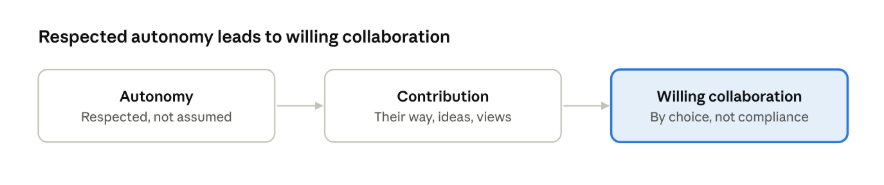
Respected autonomy becomes contribution, and contribution becomes collaboration by choice.
Each stage depends on the one before it. If you skip autonomy and go straight to demanding collaboration, you get compliance at best.
Forced and expected collaboration
Forced collaboration is dictation, a form of dictatorship. Expected collaboration, where you assume someone will go along because they work with you, offends a person’s independence.
If you reach that point with a person, sabotage can follow. It may be open or quiet: missed effort, slow responses, withheld ideas. How far it goes is unknown and varies from person to person. The safest course is never to reach that point.
Inviting contribution
Instead of announcing how something will be done, ask the person for their view. You are not obliged to accept every suggestion. The person had the opportunity to contribute before the decision was made, and that is what counts.
Illustrations.
- Assumed: “We’re doing it this way.” PermBase: “Do you have a view on how we should approach this? What do you think?”
- Assumed: “You’ll present the results to the board.” PermBase: “Would you like to present the results to the board? Your work deserves the room. What do you think?”
- Assumed: “Use the template I sent.” PermBase: “There is a template that may help. Do you think it would work for this, or do you have a better approach in mind?”
When you receive a view you do not share, thank the person, consider it honestly, and explain your decision with respect. A person whose contribution was heard and declined is far more willing to contribute next time than one who was never asked.
The permission sequence
The permission sequence turns the core rule into steps you can follow in any conversation, spoken or written.
| Step | What it asks for | Example wording |
|---|---|---|
| One: attention | To come aboard | “Hi Maria, may I ask you a quick question?” |
| Two: the request | To add the object | “Do you think it would be possible to review the summary by Thursday?” |
| Three: the action | Their view on what you asked | “What do you think?” |

Each step waits for the person to respond before the next one begins.
Step one: attention. The first permission addresses the emotional state. It is short, courteous, and easy to decline. Wait for the answer. If now is not a good time, accept it graciously and offer another: “Of course. Would later this afternoon suit you better?”
Step two: the request. Once attention is given, make the request. Be specific about the task and the deadline. A vague request makes the person work to understand what you want. Frame it as a question about possibility: “Do you think it would be possible to…?”
Step three: the action. Invite the person’s view: “What do you think?” It turns the request into a conversation and gives the person the opportunity to contribute, adjust, or raise a concern.
At least two permissions. Never less than two.
Most requests need at least two permissions: one for attention and one for the request. Never less than two.
Scale up for larger requests. A significant change in someone’s workload may need several: permission to talk, permission to explain, permission to ask, and time for them to consider. Do not over-ask on small ones. Five permissions for a one-line answer becomes tiresome and can sound insincere.
Why asking works
Some professionals worry that asking invites refusal. Research suggests people tend to underestimate how willing others are to agree to a direct request for help (Flynn and Lake, 2008)5. The findings come mainly from controlled studies of requests between strangers, so treat them as encouraging rather than conclusive for every workplace.
Caution: do not confirm or repeat
Once a person has agreed, do not confirm or repeat their commitment back to them. “So, just to confirm, you’ll have it by Friday?” may come across as mistrust, as though you do not believe them.
If they said they will do something, take that as their word. They are responsible for it. If it is not done, you can raise the matter with them later, respectfully, because the responsibility is theirs.
Do not intervene in their responsibility unless it is necessary. If you step in, you may take on that responsibility yourself without realising it, and the person loses ownership of their own work.
A simple thank-you closes the conversation well: “Great, thank you for that.”
Illustration: a complete conversation.
You: “Hi Maria, if you don’t mind, may I ask you a quick question?”
Maria: “Of course.”
You: “Do you think it would be possible to review the budget summary by Thursday? It’s two pages.”
Maria: “Thursday works.”
You: “What do you think of the approach in it, once you’ve had a look?”
Maria: “I’ll let you know.”
You: “Great, thank you for that.”
The language of permission
The same request can cross a boundary or respect it depending on the words you choose.
Sentence structures that respect autonomy
| Structure | What it does | Example |
|---|---|---|
| “May I…?” | Asks permission to enter | “May I ask you a quick question?” |
| “Can I please ask?” | Signals a request is coming, and asks first | “Can I please ask? Do you think it would be possible…?” |
| “Is it possible…?” | Asks about feasibility | “Is it possible to move the meeting to Thursday?” |
| “Do you think it would be possible…?” | Invites their judgement on the request | “Do you think it would be possible to finish the draft by Friday?” |
| “Do you think we can…?” | Frames the work as shared | “Do you think we can close this out this week?” |
| “Would you like to…?” | Offers rather than assigns | “Would you like to lead the client call?” |
| “What do you think?” | Invites their view | “Here’s the plan. What do you think?” |
| “Do you have a view on…?” | Asks for their contribution | “Do you have a view on which vendor to choose?” |
| “What are the chances of doing this by [time]?” | Invites a realistic estimate | “What are the chances of having this by Wednesday?” |
“What are the chances…?” invites a realistic estimate instead of a yes or no. A person who says “about fifty-fifty” has told you something useful and has not been forced into a promise they may not keep.
The standard wording
“Can I please ask? Do you think it would be possible…? What do you think?”
The first sentence asks for attention. The second makes the request. The third invites the person’s view. Learn the three until they come naturally.
Opening courtesies
- “If you don’t mind…”
- “When you have a moment…”
- “I hope your week is going well.”
- “I can see you’re busy, so I’ll be brief.”
Words and sentences to remove
Some words block or redirect communication. They carry meanings the speaker may not intend, and the listener hears them clearly.
“But.” “But” usually signals a no. Whatever came before it is cancelled in the listener’s mind.
- Instead of: “That’s a good idea, but we don’t have the budget.”
- Say: “That’s a good idea. Do you think we could find a way to fund it within this quarter’s budget?”
“Should.” “Should” assumes authority. If the person does what you said, they obeyed you; if they do not, they defied you.
- Instead of: “You should send that today.”
- Say: “Do you think it would be possible to send that today?”
Overly direct language. Language that tells someone what to do crosses the boundary. Ask whether they can do it instead.
- Instead of: “Call the client and fix this.”
- Say: “Would you be able to call the client about this? What do you think would resolve it?”
Self-focused pronouns. Use “I,” “me,” and “my” as little as possible. It’s about them, not you.
- Instead of: “I need you to finish this for me.”
- Say: “Do you think it would be possible to finish this by Friday?”
Conditional “if” statements. An “if” that sets a condition or a consequence turns a request into a threat. The listener hears pressure, not permission.
- Instead of: “If this isn’t done by Friday, I’ll have to escalate it.”
- Say: “This needs to reach the client by Friday. Do you think that timing will work? What would help you get there?”
Not every “if” goes. Courteous phrases that offer the person an easy way out, such as “If you don’t mind” or “If the timing doesn’t suit you, I completely understand,” are permission, not pressure. They stay.
Tone
The right words in the wrong tone still cross the boundary. A permission asked impatiently is heard as a command with a question mark. Speak calmly, leave space for the answer, and mean the question when you ask it.
Real choices and fixed requirements
Not everything at work is optional. Deadlines exist, compliance is required, and some tasks belong to a role whether the person wants them or not. PermBase does not pretend otherwise.
A real choice is an option the person can actually decline or change. A fixed requirement is something that is not optional.
The first rule is honesty: ask only when the choice is real, and state fixed requirements as fixed. Asking a question when the answer is already decided is a false choice. The person will notice, and your next question will carry less weight.
The obligation does not change the manner
Even when a person is obligated to do the work, and is highly likely to do it, PermBase does not permit harsh or direct communication. You still respect their autonomy and their boundary.
People know what their job is and what is required of them. They do not need to be reminded with force. Give them room to grow.
Phrases to avoid
Some phrases are common in workplaces that use the older style. Each one reminds a person of their obligation with force.
| Avoid | Say instead |
|---|---|
| “That’s your job.” | “This sits within your role, and your approach to it would be valued. Do you think it would be possible to have it by Friday?” |
| “You have to do it.” | “This one needs to be done. What would be the best way for you to approach it?” |
| “You have no choice.” | “This one is a fixed requirement, and it seemed right to let you know in good time. Is there anything that would make it easier?” |
| “You need to stay back.” | “Do you think it would be possible to stay a little later today? It may not suit you, and that is understood.” |
| “I need this by 3 p.m.” | “Do you think it would be possible to have this by 3 p.m.?” |
Working sentences
A working sentence gives autonomy while making a reasonable request to do as asked. It states the requirement plainly and leaves the person in charge of how, and often when, within it.
Illustration.
- Harsh: “The compliance training is mandatory. Finish it by the 30th.”
- PermBase: “Hi Ana, may I ask you a quick question? The compliance training needs to be completed by everyone by the 30th. Do you think that timing will work for you?”
- Once she replies: “Great, thank you for that.”
Illustration.
- Harsh: “Your report is due to the board on Monday. Don’t be late.”
- PermBase: “Hi Raj, if you don’t mind, may I speak with you about the board report? It needs to reach the board by Monday. What would be the best way for you to approach it?”
Where the choice still lives
A fixed requirement rarely removes every choice. Look for the parts that remain open, and offer those.
| Fixed | Often still open |
|---|---|
| That the work is done | How it is done |
| The final deadline | When, within the deadline, the person works on it |
| The standard required | The approach to reaching it |
| Attendance | Preparation, questions, and contribution |
Communicating with a group
When you speak to a group, there is a group boundary, and inside it each person keeps their own boundary and autonomy. Group consent does not override individual autonomy.
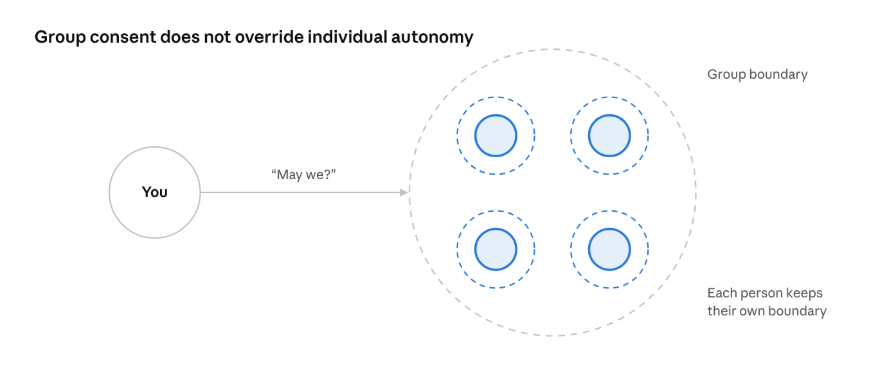
Ask the group first, then invite each person. Each person’s own boundary still stands inside the group.
- Ask the group. “If you don’t mind, and if everyone is comfortable with it, could we take ten minutes on the project timeline? What does everyone think?”
- Invite each person. “Do you have a view on this, Sam? What do you think, Priya?”
- Leave room to decline or differ. A person who stays quiet or disagrees has used their autonomy. Accept it.
- Handle concerns privately. If you notice a concern, speak with the person later, privately, never in public.
Silence is not consent
When a group agrees, it is tempting to treat every member as having agreed. Some people agree out loud; others stay silent because speaking against a group is uncomfortable. Inviting each person by name gives them a protected moment to contribute. Invite; do not put on the spot. “Do you have a view on this?” can be declined. “Why haven’t you said anything?” cannot.
Never correct in public
A concern raised in front of others crosses two boundaries at once: the person’s own, and their standing within the group. Note it and speak with the person afterwards: “If you don’t mind, may I have a quick word about the meeting earlier?”
Illustrations.
- Opening a meeting. Crossing: “Right, let’s start. First item is the budget.” Respecting: “Good morning, everyone. Thank you for your time. If everyone is comfortable with it, may we begin with the budget?”
- A quiet member. Crossing: “Anna, you’ve been quiet. What’s wrong?” Respecting: “Anna, do you have a view on this? No pressure if you’d rather think it over.”
When the method meets resistance
Most people respond reasonably when spoken to respectfully and asked within reason. There are still times when the method will not produce a cooperative response.
The manner does not change. PermBase does not change its manner for difficult people. A person who resists you does not lose their boundary, and you do not gain a right to cross it. Remaining courteous protects your own standing and leaves the door open for a different response next time.
First, check the method. Before concluding that a person is troublesome, check your own approach:
- Did you ask for attention before raising the object?
- Was the request specific, with a clear task and deadline?
- Was the choice real, or was a fixed requirement disguised as a question?
- Was the timing considerate of their state?
- Did your care match the size of the imposition?
Troublesome or toxic behaviour. If a person is troublesome or toxic, contact HR. Do not try to manage persistent problem behaviour through communication technique alone, and do not abandon the method in frustration.
Proper channels. The method does not mean accepting harassment, discrimination, or unsafe conditions. Raise those matters through the proper channels.
Emergencies. In an emergency, people do as they need to.
Business mode
PermBase asks you to put others first in every conversation. Business mode is the stance that makes that possible.
At work, you are in business mode, and your focus is on the people you manage and lead. Your goal is to grow and to build your legacy by being the best professional you can be. Your workplace is where you perform as a high-level professional, and that means it is about other people.
Your needs matter. Their place is outside work: with your family, your friends, your children if you have them, and the life you lead beyond your career.
A professional who comes to work seeking to have their own needs met will find PermBase difficult. Every permission feels like a concession. A professional in business mode experiences the same moments as part of the work, and the method becomes how a professional communicates.
In short: play the game.
The method at a glance
- It’s not about me. It’s about them. No exceptions.
- Emotional state, then object. The person first, the matter second.
- Autonomy is the core. It sits behind every person’s boundary.
- Permission is the way in. Ask; never take.
- Every person captains their own boat. You are a visitor. Payment and contract do not change that.
- The fleet sets the destination. Each captain steers their own boat.
- Independent means contributive. Autonomy leads to contribution, and contribution to willing collaboration.
- At least two permissions. Never less than two. Scale up for larger requests.
- Take people at their word. Do not confirm or repeat a commitment.
- Ask only when the choice is real. State fixed requirements as fixed, and courteously.
- Group consent does not override individual autonomy. Raise concerns privately.
- The manner never changes. Not for difficult people, not under pressure.
Before you speak, ask yourself:
- Have I considered this person’s state before my request?
- Am I asking for their attention, or taking it?
- Is this a real choice or a fixed requirement, and am I saying which?
- Have I left room for their view?
How to use the practice chapters
Each chapter that follows practises one part of the method, in the order you have just read it. Write your answers, then say them aloud: the method lives in speech. Exercises marked With a partner work best with a teacher or colleague playing the other person. Every scenario is an illustration; wherever you can, replace it with a real situation from your own work, with names and confidential details removed.
Sources
-
Ryan, R. M., and Deci, E. L. (2000). Self-determination theory and the facilitation of intrinsic motivation, social development, and well-being. American Psychologist, 55(1), 68–78. https://doi.org/10.1037/0003-066X.55.1.68 ↩
-
Gagné, M., and Deci, E. L. (2005). Self-determination theory and work motivation. Journal of Organizational Behavior, 26(4), 331–362. https://doi.org/10.1002/job.322 ↩
-
Brown, P., and Levinson, S. C. (1987). Politeness: Some Universals in Language Usage. Cambridge University Press. ↩
-
Matsumoto, Y. (1988). Reexamination of the universality of face: Politeness phenomena in Japanese. Journal of Pragmatics, 12(4), 403–426. https://doi.org/10.1016/0378-2166(88)90003-3 ↩
-
Flynn, F. J., and Lake, V. K. B. (2008). “If you need help, just ask”: Underestimating compliance with direct requests for help. Journal of Personality and Social Psychology, 95(1), 128–143. https://doi.org/10.1037/0022-3514.95.1.128 ↩